
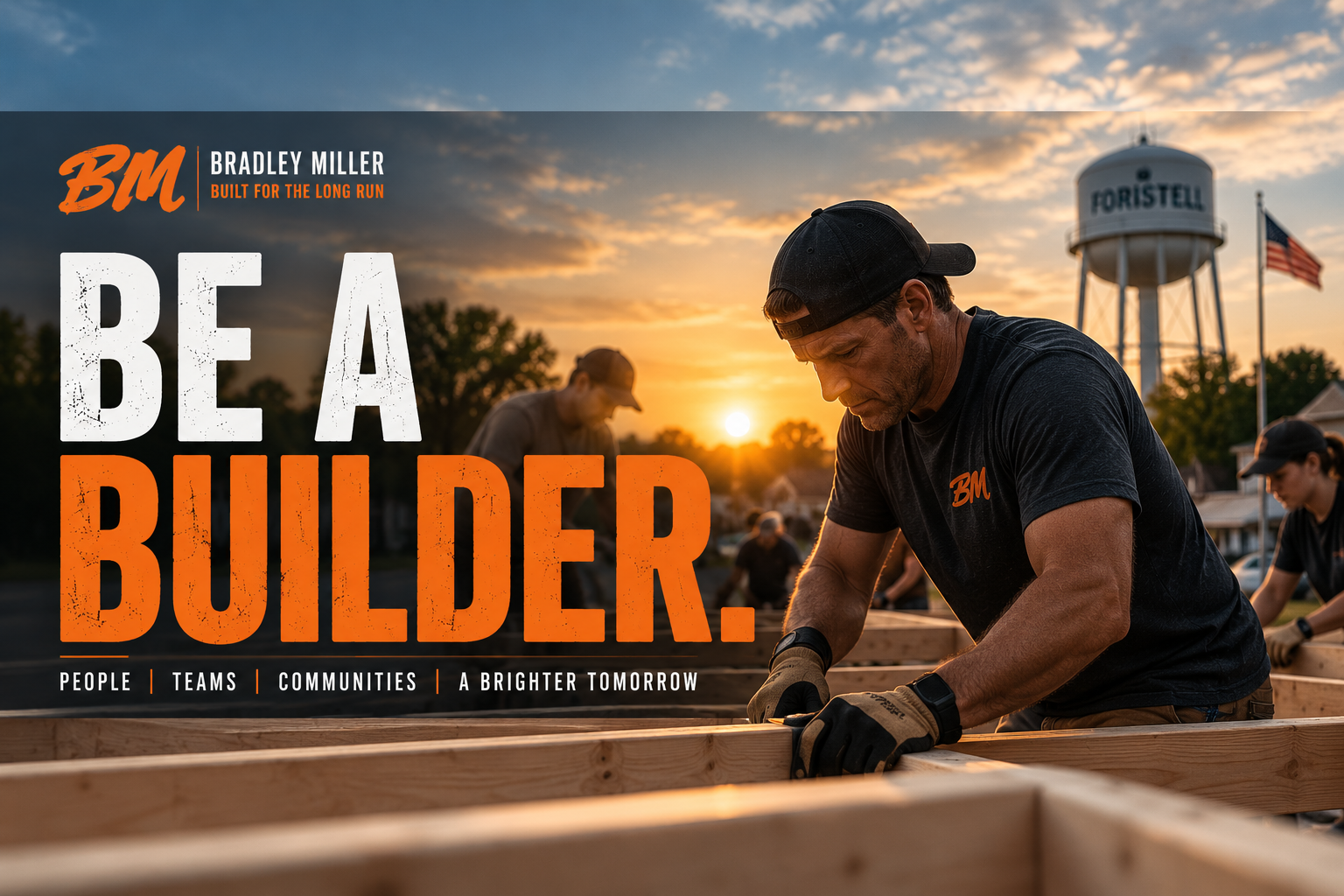
During my time as Mayor of Foristell, Missouri, someone I consider both a friend and a mentor shared an idea with me that has stuck.
He told me there are two kinds of people you’ll encounter when you’re trying to move something forward:
Builders and wreckers.
I’d heard versions of the idea before, but then he made it personal.
He told me one of the things he had noticed about me was that I was a builder.
I’ve thought about that conversation many times since.
Not because I think I’ve always gotten leadership right. I haven’t.
Not because every idea I’ve had has been a good one. It hasn’t.
And certainly not because everything I’ve tried to build has worked.
But I do think he recognized something about how I naturally approach people, organizations and opportunities.
My instinct is to ask what something could become.
How can we make this better?
What can we create?
How can we solve the problem?
Who can we bring together?
What opportunity are we missing?
How can we help someone become better than they were yesterday?
I’ve always wanted to see the best in people. Sometimes, perhaps, even when the evidence suggested I should be a little more cautious.
But I’d still rather begin by looking for someone’s potential than searching for their flaws.
I’d rather build.
Wrecking is easier.
That’s something I’ve come to understand.
It takes time to build trust.
Seconds can destroy it.
It can take months or years to create momentum.
A few decisions can stop it.
It takes courage to put an idea on the table and say, I think we can make this better.
It takes considerably less courage to sit on the sidelines and explain everything that’s wrong with it.
That’s not to say disagreement makes someone a wrecker.
Quite the opposite.
Good builders need people willing to challenge them.
They need someone asking the uncomfortable question.
They need people who see the flaw in the plan before it becomes an expensive mistake.
I’ve had people challenge my ideas and make them considerably better.
Constructive disagreement is part of building.
Wrecking is different.
Wrecking is criticism without contribution.
It’s protecting the status quo simply because change is uncomfortable.
It’s allowing personalities to become more important than purpose.
It’s spending more energy explaining why something can’t work than figuring out how it might.
I’ve never understood what that accomplishes.
Maybe that’s because building is simply how I’m wired.
Then there are the trenches.
During my time as mayor, I had another conversation that challenged the way I thought about leadership.
Someone questioned how involved I was in some of the work.
The argument was essentially that someone in the mayor’s position should delegate more.
Let other people “do the work.”
There’s truth in that.
One of the responsibilities of leadership is delegation.
If everything requires the leader’s personal involvement, you’ve created a dependency—not an organization.
As responsibilities grow, leaders have to become better at identifying the right people, giving them authority, trusting them to execute and then getting out of their way.
I’m learning more about that myself as my responsibilities continue to change.
But I don’t believe leadership automatically means leaving the trenches.
Especially in a small community.
Foristell isn’t a massive city with thousands of employees and a department for every problem.
Sometimes there simply aren’t enough people.
Sometimes something needs to get done.
And sometimes the most valuable thing a leader can do isn’t issue another instruction.
It’s show up.
Roll up your sleeves.
Stand beside somebody.
And help.
I don’t think leadership is choosing between delegating and doing.
I think leadership is knowing which one the moment requires.
There are times when doing the work yourself actually hurts the team because you’re taking away someone else’s opportunity to lead.
There are times when you need to step back.
There are times when your job is to set the direction, provide resources and trust your people.
But there are also moments when people need to see that you’re willing to stand beside them.
A title shouldn’t make you too important to help.
That’s something I believe deeply.
Whether that’s in a city, a business, a family, a volunteer organization or anywhere else people are trying to accomplish something together.
Leadership has a way of revealing people.
It revealed things about others during my time as mayor.
It revealed things about me, too.
Some I liked.
Some I needed to work on.
And that’s probably another reason the builder analogy has stayed with me.
Because builders aren’t only building organizations.
We’re building ourselves.
We’re building relationships.
We’re building teams.
We’re building reputations.
We’re building trust.
We’re building people.
And every interaction puts another brick somewhere.
The question is what we’re building with it.
That’s why kindness matters.
That’s why communication matters.
That’s why relationships matter.
That’s why knowing when to ask for help matters.
That’s why understanding the consequences of our decisions matters.
And that’s why I think leaders occasionally need to get down in the trenches.
Not for recognition.
Not so everyone can see how hard they’re working.
But because leadership is ultimately about people.
And people need more than instructions.
They need to know you see them.
They need to know their contribution matters.
Sometimes they need direction.
Sometimes they need accountability.
Sometimes they need you to get out of their way.
And every once in a while, they need you standing right beside them with your sleeves rolled up.
It’s been nearly a year that’s passed since my friend told me I was a builder.
I hope he was right.
More importantly, I hope I continue earning that description.
Because there will always be things available to tear down.
There will always be flaws to point out.
There will always be reasons something won’t work.
There will always be people we can criticize.
Building asks something harder of us.
See what could be.
Then accept some responsibility for helping it become that.
Build the relationship.
Build the person.
Build the team.
Build the community.
Build yourself.
And when something truly does need to come down, don’t stop with the demolition.
Help build something better in its place.
Because long after the title changes, the position ends, or someone else takes your place, people may not remember every decision you made.
But somewhere, someone may still be standing a little taller because you helped build them up.
And you may never even know it.
Be a builder.
#MondayMilesAndLeadership
#BuiltForTheLongRun
#Leadership #Relationships #Community #LeadByExample